Best practices for your content formats
Different formats. Different audiences. Different jobs. Levragd adapts the content to fit all three.
Here are the rules we hold each format to: what it’s for, how it’s built, how long it runs, how it should sound, and what to avoid. Treat them as guidelines, not laws.
By Christopher Vigneron, who has spent more than 20 years as a teacher, editor, copywriter, and content designer.
Last updated October 5, 2026
The eight formats at a glance
Each format at a glance. Select a format to jump to its full guide.
| Format | Best for | Typical length | Structure |
|---|---|---|---|
| Articles | Teach, answer, and earn trust over time. | 800 to 2,000 words | Headline, intro, descriptive sections, examples, conclusion |
| LinkedIn posts | Share a real insight with other professionals. | 100 to 300 words | Hook, idea, development, takeaway |
| Newsletters | Give readers a reason to open the next issue. | 300 to 800 words | Subject line, preview text, hook, main idea, call to action |
| FAQs | Answer the question, then stop. | 30 to 75 words for a simple answer, 75 to 200 for a complex one | Question, direct answer, supporting detail |
| Product updates | Say what changed for the reader, not what you built. | 50 to 150 words for a small update, 150 to 400 for a medium one | What’s new, what changed, why it matters, what to do |
| Social media posts | One parent format, with different rules for each platform. | 20 to 250 words, depending on the platform | Strong opening, one idea, takeaway or payoff |
| Sales snippets | Make the value obvious in a few words. | Headline: 5 to 12 words. Supporting copy: 20 to 60 words. Call to action: 2 to 5 words | Problem, value, proof, action |
| Article ideas | Find reasons to publish, not just topics. | A few lines per idea | Working title, core idea, audience, intent, angle |
Want it on one page? Download the one-page cheat sheet (PDF), or get it as an image (PNG).
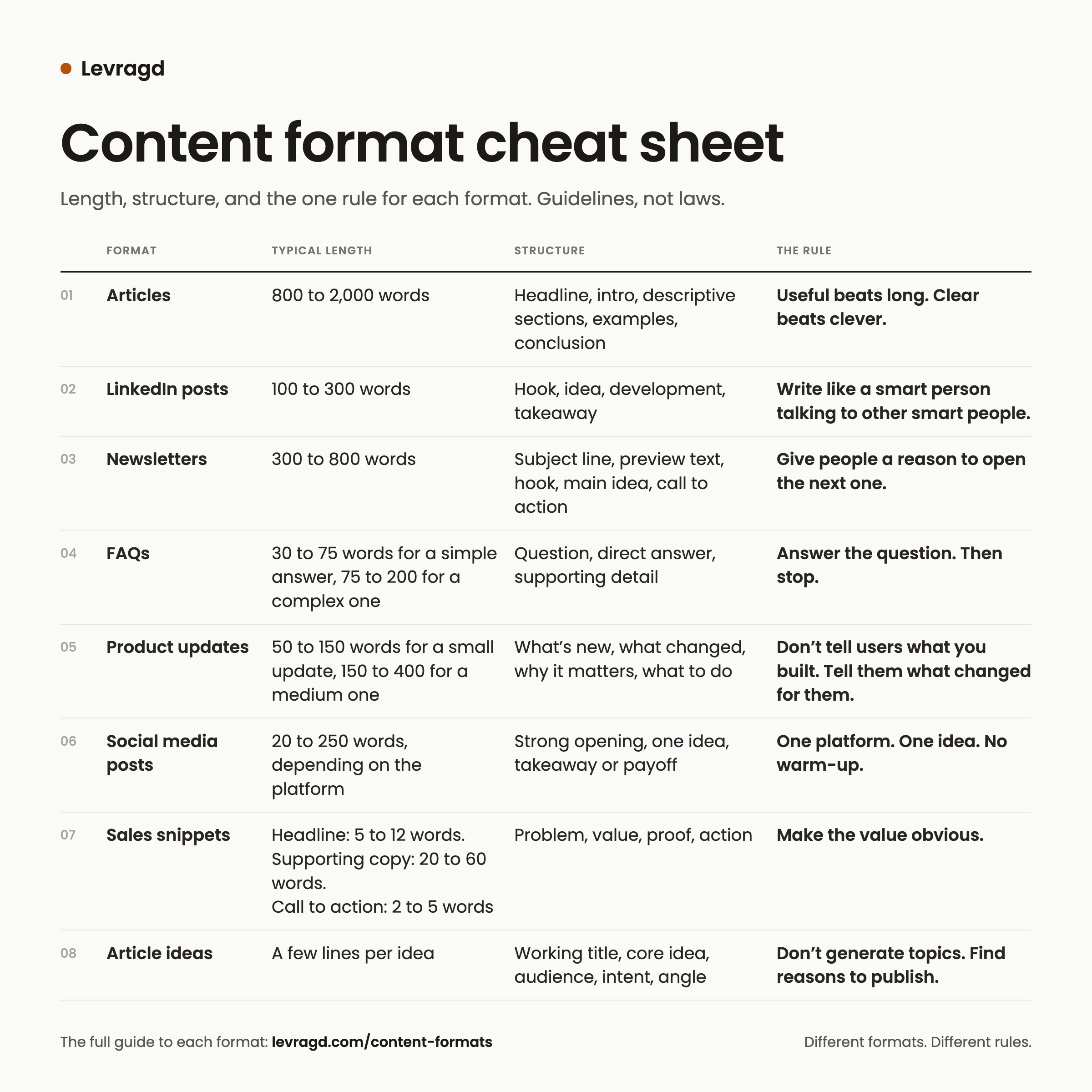
The rules behind the rules
Format matters.
An article isn’t a LinkedIn post with more words.
Purpose comes first.
Know the audience, the goal, the intent, the context, and the action you want before writing a word.
Useful beats long.
Never add words just to hit a target.
Clear beats clever.
Understanding comes before cleverness.
Write for humans first.
Search optimization should help people find the writing, not make it robotic.
Every sentence needs a job.
Question anything that doesn’t inform, clarify, persuade, guide, or move the reader forward.
The format library
Eight formats, each laid out the same way: what it’s for, how it’s built, how long it runs, how it should sound and look, what to avoid, and what Levragd looks for.
Articles
Teach, answer, and earn trust over time.
How long should an article be?
Long enough to answer the question and no longer. Most useful articles run 800 to 2,000 words, but that’s a guideline, not a target. A simple topic can be shorter, and a genuinely complex one can run longer. Lead with the answer, then add only what helps the reader.
The ruleUseful beats long. Clear beats clever.
Purpose
Educate, answer questions, establish expertise, capture search intent, explain complexity, support buying decisions, and build organic visibility.
Length
800 to 2,000 words
A guideline, not a target. Shorter is better for simple subjects. Longer is justified only by genuine complexity.
Structure
- 1Clear headline
- 2Short introduction
- 3Descriptive H2 and H3 sections
- 4Examples, bullets, tables, or callouts where they help
- 5A useful conclusion or next step
Style
- Lead with useful information.
- Use short to medium paragraphs.
- Explain jargon when it first appears.
- Prefer concrete examples to general claims.
Formatting
- Write for scanning as well as reading.
- Use bullets, numbered lists, and tables when they improve comprehension.
- Avoid walls of text and decorative formatting.
SEO and AEO
- Match the search intent.
- Answer the primary question clearly, early.
- Use natural variations of the topic.
- Use descriptive headings.
- Give concise definitions.
- Answer the likely follow-up questions.
- Don’t stuff keywords.
Common mistakes
- Adding words just to hit a target length.
- Turning every article into an SEO essay.
- Stuffing keywords into sentences.
- Using jargon because it sounds professional.
- Writing a clickbait headline the article can’t support.
What Levragd looks for
- Search intent
- Topical coverage
- Structure
- Clarity
- Differentiation
- Question answerability
- Brand voice
Levragd’s quality check reviews every draft against 21 criteria. These are the ones that matter most for this format.
LinkedIn posts
Share a real insight with other professionals.
How long should a LinkedIn post be?
Most strong LinkedIn posts run 100 to 300 words. Longer is fine when the story or the argument earns it. Open with a specific hook, keep paragraphs short, and end with one takeaway. Length matters less than whether every line moves the reader forward.
The ruleWrite like a smart person talking to other smart people.
Purpose
Professional insight, thought leadership, personal experience, commentary, lessons learned, industry observations, and useful conversation.
Length
100 to 300 words
Longer is fine when the story or the argument earns it.
Structure
- 1Hook
- 2Idea
- 3Development
- 4Takeaway
Style
- Conversational but intelligent.
- Specific experiences beat generic advice.
- Use the first person where it fits.
- Don’t add engagement bait.
Formatting
- Short paragraphs and intentional whitespace.
- Bullets can help.
- Emojis and hashtags are optional and depend on the brand.
Common mistakes
- Opening with a generic hook that could start any post.
- Ending with a question just to farm comments.
- Adding emojis because LinkedIn supposedly needs them.
- Giving generic advice instead of one specific experience.
What Levragd looks for
- Brand voice
- Specificity
- Clarity
- Audience fit
- Unsupported claims
Levragd’s quality check reviews every draft against 21 criteria. These are the ones that matter most for this format.
FAQs
Answer the question, then stop.
How long should an FAQ answer be?
Keep simple answers to 30 to 75 words and complex ones to 75 to 200. Put the actual answer in the first sentence, then add supporting detail. If an answer needs much more than that, it’s probably two questions.
The ruleAnswer the question. Then stop.
Purpose
Answer real customer questions, remove friction, support decisions, clarify confusing concepts, and support search and AI discovery.
Length
30 to 75 words for a simple answer, 75 to 200 for a complex one
If an answer needs more than that, it’s probably two questions.
Structure
- 1Question
- 2Direct answer
- 3Supporting detail
Style
- Write questions the way people actually ask them.
- Put the real answer at the beginning.
- Use direct, factual language and avoid marketing fluff.
Formatting
- One question addresses one topic.
- Define important terms explicitly.
SEO and AEO
- Use natural-language questions.
- Answer directly.
- Don’t combine unrelated questions.
- Define the terms that matter.
Common mistakes
- Turning an FAQ into a 700-word article.
- Burying the answer under a warm-up.
- Combining unrelated questions into one.
- Answering a question nobody asked.
What Levragd looks for
- Question answerability
- Clarity
- Relevance
- Unsupported claims
- Search intent
Levragd’s quality check reviews every draft against 21 criteria. These are the ones that matter most for this format.
Product updates
Say what changed for the reader, not what you built.
How do you write a product update?
Lead with what changed for the user, not what you built. A good update says what’s new, why it matters, how it works if that isn’t obvious, and what the reader needs to do, if anything. Small updates run 50 to 150 words.
The ruleDon’t tell users what you built. Tell them what changed for them.
Purpose
Tell users what changed, why it matters, what they can now do, and whether they need to act.
Length
50 to 150 words for a small update, 150 to 400 for a medium one
Major releases can run longer when the length is justified.
Structure
- 1What’s new
- 2What changed
- 3Why it matters
- 4How it works (if needed)
- 5What you need to do (if anything)
Style
- Lead with the benefit to the user.
- Write for your audience, not for developers, unless developers are the audience.
- Use official product names consistently.
Formatting
- Skip unnecessary technical detail.
- Skip exclamation marks.
- Make any required action impossible to miss.
Common mistakes
- Writing a product update like a press release.
- Describing the build instead of the benefit.
- Calling the same feature by three different names.
- Hiding the one thing the reader has to do.
What Levragd looks for
- Usefulness
- Clarity
- Terminology
- Unsupported claims
- CTA quality
Levragd’s quality check reviews every draft against 21 criteria. These are the ones that matter most for this format.
Sales snippets
Make the value obvious in a few words.
How do you write a sales snippet?
Lead with the customer’s problem, then the value, the proof, and one action. Headlines run 5 to 12 words, supporting copy 20 to 60, and a call to action 2 to 5. Be specific, cut unnecessary adjectives, and avoid superlatives you can’t support.
The ruleMake the value obvious.
Purpose
Headlines, landing-page sections, product descriptions, sales emails, value propositions, feature and benefit statements, calls to action, and sales decks.
Length
Headline: 5 to 12 words. Supporting copy: 20 to 60 words. Call to action: 2 to 5 words
Used flexibly. Not every snippet needs all four steps.
Structure
- 1Problem
- 2Value
- 3Proof
- 4Action
Style
- Lead with the customer’s problem or the outcome they want.
- Benefits before features where possible.
- Specific beats impressive.
- Remove unnecessary adjectives.
Formatting
- Use one primary call to action.
- Avoid unsupported superlatives.
Common mistakes
- Adding a call to action where one doesn’t belong.
- Claiming “the best” or “the fastest” with nothing behind it.
- Leading with features instead of the problem.
- Stacking adjectives in place of specifics.
What Levragd looks for
- Specificity
- Unsupported claims
- Invented customer information
- CTA quality
- Differentiation
Levragd’s quality check reviews every draft against 21 criteria. These are the ones that matter most for this format.
Article ideas
Find reasons to publish, not just topics.
How do you come up with article ideas?
Look for reasons to publish, not just topics. Good ideas come from customer questions, product knowledge, industry changes, search intent, and gaps in your existing content. Each idea needs an audience, an intent, an angle, and a reason it’s worth publishing now.
The ruleDon’t generate topics. Find reasons to publish.
Purpose
Article ideas aren’t articles. The goal is to identify worthwhile reasons to publish.
Length
A few lines per idea
An idea is a brief, not a draft.
Structure
- 1Working title
- 2Core idea
- 3Audience
- 4Intent: informational, commercial, transactional, navigational, or thought leadership
- 5Angle
- 6Potential format: how-to, explainer, comparison, case study, opinion, list, guide, FAQ, research, or trend analysis
- 7SEO and AEO opportunity
Style
- Prefer ideas based on customer questions, product knowledge, industry changes, search intent, and gaps in existing content.
- Also look to internal expertise, contrarian observations, data, customer problems, and emerging topics.
Formatting
- Give every idea the same fields so the ideas can be compared.
SEO and AEO
- Note the search or answer opportunity for each idea, but never pick an idea on keyword volume alone.
Common mistakes
- Generic ideas any company could publish.
- Obvious AI output nobody needs another copy of.
- Duplicates of what the company already published.
- Ideas that are too broad to write well.
- “10 ways” lists with no real reason for the format.
What Levragd looks for
- Audience fit
- Search intent
- Differentiation
- Relevance
- Usefulness
Levragd’s quality check reviews every draft against 21 criteria. These are the ones that matter most for this format.
What good content avoids
Whatever the format, good content avoids these.
- Adding words just to hit a target length.
- Turning every article into an SEO essay.
- Writing every social platform the same way.
- Adding a call to action where one doesn’t belong.
- Stuffing keywords into sentences.
- Using jargon because it sounds professional.
- Turning every headline into clickbait.
- Adding emojis because social media supposedly needs them.
- Writing a product update like a press release.
- Turning an FAQ into a 700-word article.
- Suggesting article ideas everyone else has already published.
Before and after
The difference between telling people what you built and telling them what changed for them.
“We’re excited to announce that we’ve made significant improvements to our platform to provide an enhanced experience for our users.”
“Onboarding just got shorter. You can now skip setup steps you don’t need yet and finish them later.”
An illustration of the difference, not a real customer’s update or result.
How Levragd uses these rules
The format shapes the work before the first word is written, not just after.
Before it writes
Each format has its own instructions. An FAQ is built as questions with direct answers, and a LinkedIn post as a short post with no headings.
While it writes
Every piece starts from your Brand DNA: who you serve, how you sound, which words to use and avoid, and which claims never to make.
After it writes
A quality check reviews the draft against 21 criteria in four groups (brand fit, accuracy & trust, writing quality, search & intent fit) and tells you what to fix. Revise applies the recommendations you choose, and you review and approve every change.
Six questions for any piece
A format is only one part of whether a piece works. These are the questions behind any good one, whatever the format.
1Format
Does it fit the medium?
2Audience
Is it right for the person reading it?
3Intent
Does it do the job it was meant to do?
4Brand
Does it sound like the company?
5Clarity
Can the reader understand it?
6Quality
Is it actually worth publishing?
One question governs the rest. Does this content work for its audience, purpose, and format? A piece that lands slightly outside a length range isn’t wrong if it works.
Know the format. Levragd handles the rest.
Give Levragd the context. Choose the format. Let it build the content around the rules that make that format work.
Free to try. No credit card. Drafts need your review and approval.
Social media posts
One parent format, with different rules for each platform.
How long should a social media post be?
It depends on the platform. A standard X post is up to 280 characters, Facebook posts typically run 50 to 250 words, and Instagram captions 50 to 200. Whatever the platform, lead with one idea and don’t warm up before the point.
The ruleOne platform. One idea. No warm-up.
Purpose
Social is a parent format with platform-specific rules. A good post is written for the platform it will live on, not written once and relabeled.
Length
20 to 250 words, depending on the platform
The platform guides below give a range for each.
Structure
Style
Formatting
Platform guides
X
Fast commentary, ideas, observations, news, conversation, and short-form expertise.
Length: A standard post is up to 280 characters
Say the thing. Don’t warm up for the thing.
Facebook
Community, discussion, storytelling, announcements, and useful information.
Length: Typically 50 to 250 words
Give people something worth responding to.
Instagram
Visual storytelling, brand identity, community, and discovery.
Length: A typical caption is 50 to 200 words
Make the visual stop them. Make the caption worth reading.
Levragd writes the words. It doesn’t design images or carousels.
TikTok
Primarily a video format, so the writing is a script.
Length: Hook in the first 3 seconds, the idea by 10, the value or story by 30 or later, then a payoff
Don’t introduce the video. Start the video.
Levragd doesn’t produce video. Treat this as guidance for the script you film.
Common mistakes
What Levragd looks for
Levragd’s quality check reviews every draft against 21 criteria. These are the ones that matter most for this format.